
On June 4, 2026, one of the most-hated rules in U.S. retail trading goes away. The end of the PDT rule means small accounts can finally actively day-trade without bumping into the $25,000 wall — but with new risks worth knowing about.
FINRA — the broker regulator — is retiring the Pattern Day Trader rule and its infamous minimum equity requirement. In its place comes a smarter system based on real-time risk, not on counting trades. Here’s what changes, why it matters, and what you need to do.
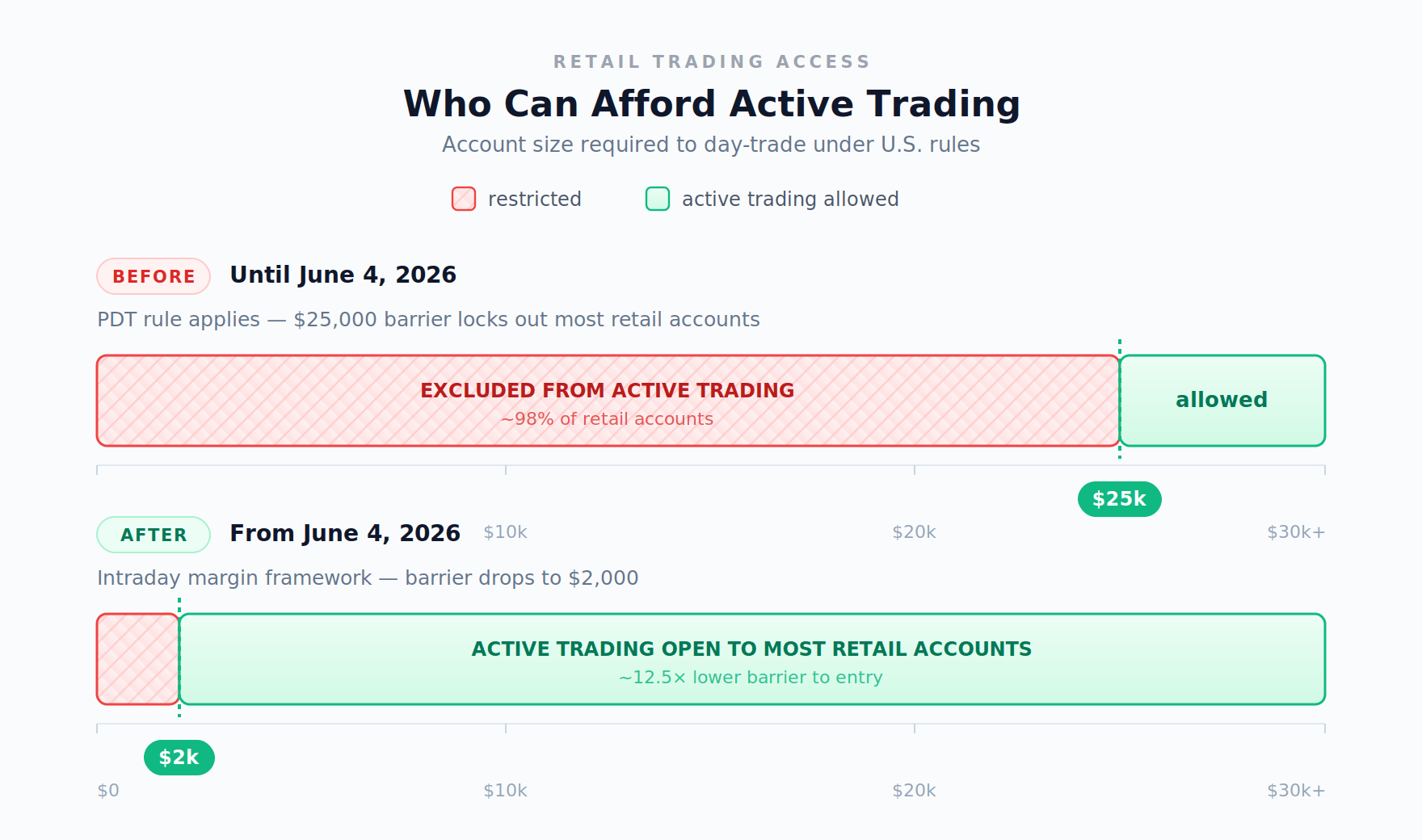
End of PDT Rule: What’s Actually Changing
The PDT rule has worked the same way since 2001: do four day trades in five business days and your broker classifies you as a Pattern Day Trader. From there, you need at least $25,000 in your account, or trading gets blocked.
After June 4, that whole framework disappears. No more $25k minimum. No more day trade counter. No more 90-day restrictions just for trading too often.
What replaces it is called the intraday margin framework — formalized in FINRA Rule 4210. Instead of counting trades, the system watches your actual exposure during the day, in real time. If your positions exceed your available margin, you get an intraday margin call — a request to top up. Fail repeatedly within 5 business days and your account can still be restricted for up to 90 days. So oversight isn’t gone — it’s just smarter.
The headline change for small accounts: the equity threshold drops from $25,000 to $2,000. With leverage on, that’s enough to unlock 4× intraday buying power.
Why this matters to you
For most retail traders, this opens a door that’s been shut for a quarter century.
If you’ve had $5,000 or $10,000 in a brokerage account but couldn’t actively day-trade because of the PDT cap, you can now. Intraday strategies, momentum rotations, mean reversion — all become economically viable on small accounts for the first time.
But it cuts both ways.
The second-order effect: algorithmic strategies finally make sense on small accounts. If you’ve been backtesting an intraday system but couldn’t run it live without $25k, you can now test it with $5,000. The technology bar has been falling for years. The regulatory bar finally caught up.
What to do
Mostly nothing. The change rolls out automatically on June 4 across all U.S. brokers.
If you’re an active or aspiring active trader, the bigger thing is to use the new freedom responsibly. The barrier is falling. The risk is still there. “I can finally do this” is not the same as “I should jump in without thinking.”
If you’ve ever wanted to test an intraday strategy live but couldn’t justify locking up $25,000 to do it, June 4 is the day that excuse runs out.
Libor Štěpán
AlgoCloud trader
Related Articles
- What is Pattern Day Trading and how to handle it in AlgoCloud? – Background on the rule that’s about to disappear
- Gap Fill Strategy with a Trend Filter – Uses 2-day holding to bypass PDT (still useful for cash accounts)
- 7 Best Algorithmic Trading Platforms for Stock Picking – Where to run your strategies once the barrier drops
- How to Build a Stock Picking Algorithm Without Coding – Build your first algo to take advantage of the new $2k threshold