Disclaimer: This article is for educational purposes only. Trading involves significant risk, and past performance is not indicative of future results. Always perform your own due diligence before risking capital.
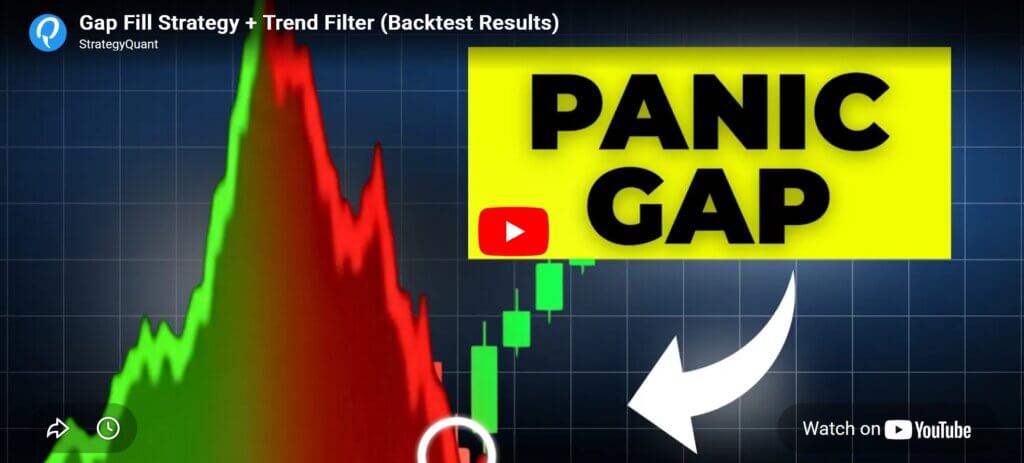
Market overreaction is a phenomenon that has been a staple of professional trading desks for decades. When the market panics and opens significantly lower than its previous trading range, it often creates a price vacuum. This strategy, designed for the AlgoCloud environment, capitalizes on the theory that buyers eventually realize a sell-off was too aggressive, causing the price to fill the gap back toward the previous day’s range.
The Core Strategy: Identifying Panic
The strategy identifies “panic” through a specific 2% threshold. We look for situations where today’s opening price is at least 2% lower than yesterday’s minimum (low).
The Logic:Open(0) < Low(1) * 0.98.
The Goal: This filter removes normal market noise and identifies a genuine disconnect between yesterday’s value and today’s opening price.
Why Small Caps?
The strategy focuses on the Russell 2000 index. Unlike the giants in the S&P 500, the Russell 2000 tracks small-cap companies that are generally more volatile and less liquid. In gap trading, this volatility is an advantage, as small-cap stocks are much more likely to experience these sharp 2% gaps that create trading opportunities.
Navigating the PDT Rule
A significant challenge for traders with accounts under $25,000 is the Pattern Day Trader (PDT) rule. To bypass this entirely, this strategy uses a two-day holding period. Because the PDT rule only applies when you open and close a position on the same calendar day, holding for two full bars removes the trade from the “day trade” definition.
Ranking the Best Opportunities
To keep the portfolio manageable, we limit ourselves to five maximum open positions at a time. The strategy uses a specific formula to find the most “panicked” stocks by normalizing the gap relative to the stock’s normal daily movement:
By dividing the gap size by the ATR, we prioritize stocks where the gap represents the largest statistical shock for that specific instrument.
Enhancing Performance with a Trend Filter
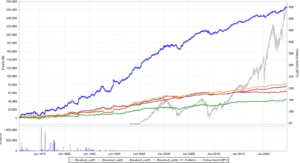
Initial backtests showed a solid equity curve but a maximum drawdown of approximately 20%. To smooth out these fluctuations, a Trend Filter was added using the IWM ticker (the Russell 2000 ETF).
The strategy only enters a gap-down trade if the broader market is in an uptrend. We define this by checking if the close of the index (with a 1-day shift) is above its 200-day moving average. By using yesterday’s confirmed trend to decide on today’s open entry, the maximum drawdown in testing dropped from 20% to 15%.
Conclusion
The Gap Fill strategy proves that logical, data-driven approaches to market panic can be highly effective when combined with the right statistical filters. By focusing on statistical shocks and staying on the right side of the long-term trend, traders can turn market volatility into a structured opportunity.
To provide the best experiences, we use technologies like cookies to store and/or access device information. Consenting to these technologies will allow us to process data such as browsing behavior or unique IDs on this site. Not consenting or withdrawing consent, may adversely affect certain features and functions.
Functional
Always active
The technical storage or access is strictly necessary for the legitimate purpose of enabling the use of a specific service explicitly requested by the subscriber or user, or for the sole purpose of carrying out the transmission of a communication over an electronic communications network.
Preferences
The technical storage or access is necessary for the legitimate purpose of storing preferences that are not requested by the subscriber or user.
Statistics
The technical storage or access that is used exclusively for statistical purposes.The technical storage or access that is used exclusively for anonymous statistical purposes. Without a subpoena, voluntary compliance on the part of your Internet Service Provider, or additional records from a third party, information stored or retrieved for this purpose alone cannot usually be used to identify you.
Marketing
The technical storage or access is required to create user profiles to send advertising, or to track the user on a website or across several websites for similar marketing purposes.
To provide the best experiences, we use technologies like cookies to store and/or access device information. Consenting to these technologies will allow us to process data such as browsing behavior or unique IDs on this site. Not consenting or withdrawing consent, may adversely affect certain features and functions.
Functional
Always active
The technical storage or access is strictly necessary for the legitimate purpose of enabling the use of a specific service explicitly requested by the subscriber or user, or for the sole purpose of carrying out the transmission of a communication over an electronic communications network.
Preferences
The technical storage or access is necessary for the legitimate purpose of storing preferences that are not requested by the subscriber or user.
Statistics
The technical storage or access that is used exclusively for statistical purposes.The technical storage or access that is used exclusively for anonymous statistical purposes. Without a subpoena, voluntary compliance on the part of your Internet Service Provider, or additional records from a third party, information stored or retrieved for this purpose alone cannot usually be used to identify you.
Marketing
The technical storage or access is required to create user profiles to send advertising, or to track the user on a website or across several websites for similar marketing purposes.